She entered soaked by the rain, overlooked and silently judged—and then she stopped, pointed at a painting, and said, “That one… it belongs to me.”
At the time, I couldn’t imagine how those quiet words would unravel my orderly world—or how they would bring someone forgotten back into it.
My name is Tyler. I’m thirty-six, and I own a modest art gallery tucked between a secondhand bookstore and a cozy café in downtown Seattle. It isn’t the kind of place filled with loud conversations or forced sophistication—no champagne flutes, no critics competing for attention. My gallery is calm. Intimate.
The wooden floors carry a soft shine. The lights glow warm against the frames. Jazz—usually Coltrane—drifts gently through the space, mixing with the scent of varnish and roasted coffee from next door.
This place exists because of my mother. She was a ceramic artist who never chased recognition, but she taught me that art matters when it tells the truth. When she passed away during my final year of art school, I lost the ability to paint. The empty canvas felt unbearable. So instead, I built a space where art could breathe—even if I no longer could.
Most days, I’m alone here. And I prefer it that way.
Until the afternoon she arrived.
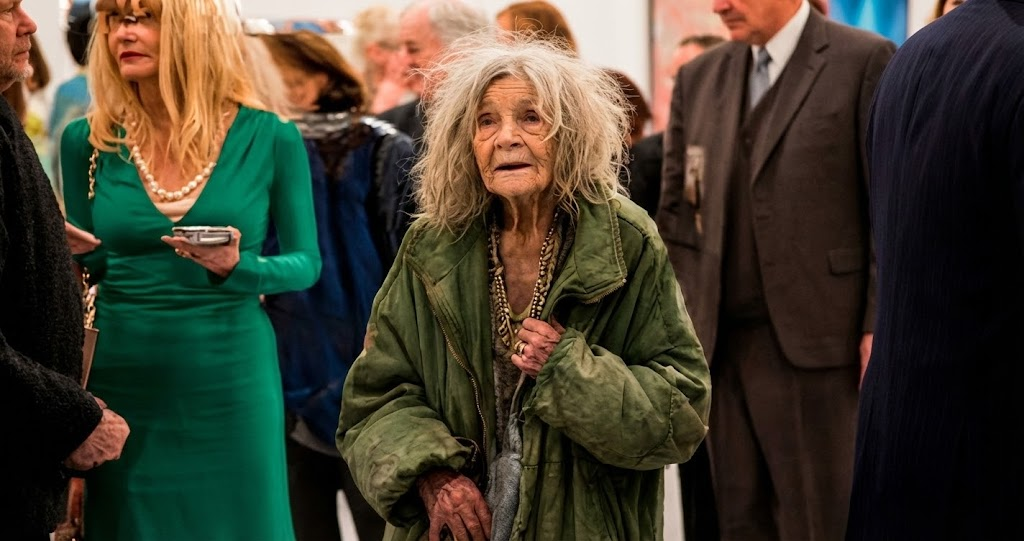
It was a gray Thursday, rain sliding endlessly down the sidewalks. I was adjusting a frame near the door when I noticed a woman standing just outside beneath the awning. She didn’t move. Her coat was soaked and heavy, her silver hair clinging to her face. She looked like someone who had lived several lifetimes—and misplaced all of them.
At the same moment, three of my regular patrons stepped inside—polished, perfumed, and perfectly comfortable judging what didn’t belong.
“Do you smell that?” one murmured.
“She’s dripping everywhere,” another complained.
“Why is she even here?”
I hesitated. Through the glass, the woman seemed uncertain—as if deciding whether warmth was worth humiliation. My assistant, Kelly, leaned toward me and whispered nervously, “Should I ask her to leave?”
I shook my head. “No. Let her come in.”
The bell chimed softly as the door opened. She stepped inside, leaving small pools of rain behind her. The room grew quiet. The women turned away dramatically.
“She doesn’t fit the place.”
“She wouldn’t understand real art anyway.”
I ignored them.
The woman moved slowly from piece to piece, studying each one with careful attention—not confusion, but recognition. She paused briefly at an impressionist painting, then continued until she reached the far wall.
A city skyline at sunrise.
One of my most treasured pieces—soft purples, burning light, and a quiet sense of loss woven into the strokes. She stopped completely.
“That painting,” she whispered. Then, with steady certainty: “It’s mine.”
Laughter followed—sharp and dismissive.
“Oh sure.”
“She’s confused.”
But the woman raised her hand and pointed to the corner of the canvas. Beneath layers of glaze were two faint initials: M. L.
My breath caught. I’d purchased the piece years ago at an estate sale. No records. No artist history. Only those initials.
“What’s your name?” I asked quietly.
She met my gaze. “Marla,” she said. “Marla Lavigne.”
I brought her a chair. Kelly returned with tea. Marla held the cup as if it might slip away.
“I painted it,” she said. “Before the fire.”
Her voice trembled. “Our apartment burned. My studio. My husband didn’t survive. When I came back, my work was gone—sold, signed away.”
She looked at her hands. “After that,” she whispered, “I disappeared.”
That night, I searched until dawn. And there it was—a faded brochure from 1990. Marla, young and radiant, standing beside the painting.
Dawn Over Ashes — Marla Lavigne.
When I showed her, she cried silently.
Over the following weeks, we restored her name. Every piece. Every record. The man who had stolen her work was exposed—arrested.
Marla didn’t celebrate. “I don’t want revenge,” she said. “I just want to exist again.”
And she did.
She painted. She taught children. She filled the studio with light.
A year later, her exhibition opened. We named it Dawn Over Ashes. The gallery overflowed.
Marla stood calm and whole. “You gave me my life back,” she said.
“No,” I replied. “You reclaimed it.”
She lifted a gold pen and signed her name beneath the painting—for the first time in decades.
Marla Lavigne — in gold.