When images of Kim Kardashian wearing a full-face mask began circulating online, the reaction was instant and intense. Fans paused mid-scroll, unsure of what they were seeing. The mask covered her entire face, leaving no expression, no eyes, no familiar features — just smooth fabric pulled tightly over her head, paired with an elegant, form-fitting outfit. In a world where Kim’s face is one of the most recognizable on the planet, the decision to hide it completely felt jarring.
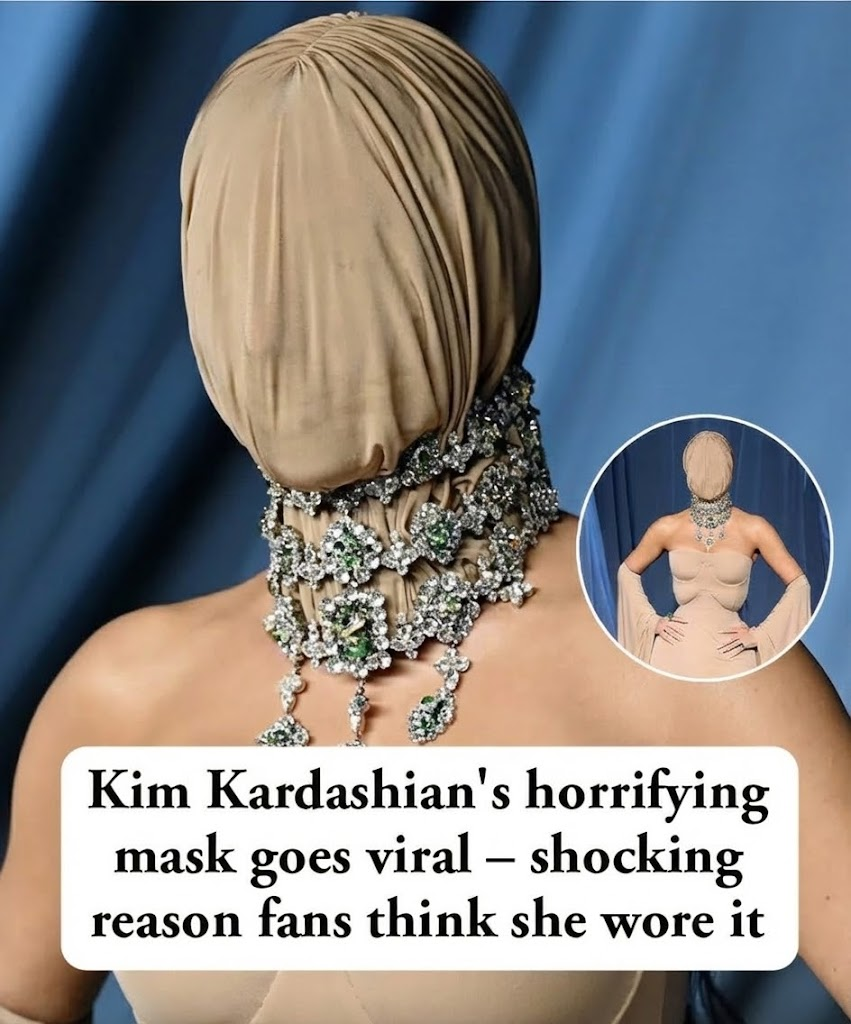
At first, confusion dominated the conversation. Some people thought the images were edited or exaggerated. Others assumed it had to be a stunt or a provocation meant to dominate headlines. But the photos were real. No filters. No digital manipulation. Kim had deliberately stepped into public view while concealing the very thing that made her famous. That contrast is what made the moment go viral.
As the images spread, interpretations multiplied. Some fans described the look as unsettling, even “horrifying,” while others praised it as bold and conceptual. Fashion critics pointed out that masking has long been used as a symbol in high fashion — representing anonymity, control, or resistance to constant surveillance. In that context, the mask wasn’t random. It was intentional, designed to make people uncomfortable enough to ask why.
Kim Kardashian’s relationship with visibility has always been complex. Her image has been endlessly consumed, analyzed, praised, and criticized for years. Every detail of her appearance is scrutinized in real time. By covering her face entirely, she reversed that dynamic. Instead of offering more access, she removed it. People could look, but they couldn’t read her. They couldn’t judge her expression. They couldn’t project emotion onto her eyes.
That loss of access seemed to unsettle many viewers more than the mask itself. Social media thrives on familiarity and relatability. The mask disrupted both. Some fans speculated that the look was a statement about privacy, fame, or the pressure of being constantly seen. Others believed it was a commentary on how women’s bodies and faces are consumed, while identity is often overlooked.
Not everyone agreed. Critics argued the look was excessive or attention-seeking, pointing out that Kim is fully aware of how quickly anything she wears will dominate the conversation. But even those criticisms fed the same outcome: discussion. The mask became less about fashion and more about the cultural moment it exposed — how uncomfortable people feel when a public figure refuses to perform familiarity.
What made the reaction stronger was the silence around it. There was no immediate explanation, no caption spelling out meaning. That absence forced people to fill in the blanks themselves. In doing so, the internet revealed its own expectations: that celebrities owe clarity, access, and constant explanation. The mask challenged that assumption by offering none of it.
Whether viewed as art, provocation, or symbolism, the masked appearance achieved something rare — it shifted the conversation from admiration or criticism of beauty to questions about identity, control, and visibility. In hiding her face, Kim Kardashian managed to make people look closer than ever.