In China’s Gansu province, 39-year-old truck driver Nie Jianwen lives a life most people never see — and rarely imagine. His days begin before sunrise and often end long after dark, guided by highways, delivery schedules, and the steady hum of an engine. But inside his truck is something far more important than cargo. Riding beside him on every single trip is his wife, Cao Yingying, the woman he calls his “first love.”
Their lives changed forever in 2020. Cao Yingying suffered a sudden brain hemorrhage that left her paralyzed and unable to care for herself. Overnight, their marriage shifted from partnership to full-time caregiving. Many people in that position are forced into impossible choices — institutional care, separation, or leaving work behind. Nie chose something else entirely. He chose togetherness, no matter the cost.
Rather than leaving his wife behind when he went on the road, Nie rebuilt his truck into a small moving home. He created space for her to rest safely, secured medical supplies, and adjusted the layout so he could care for her properly. From that moment on, wherever the truck went, Cao went too. Distance, fatigue, and logistics no longer mattered as much as one simple truth: she would not face life alone.
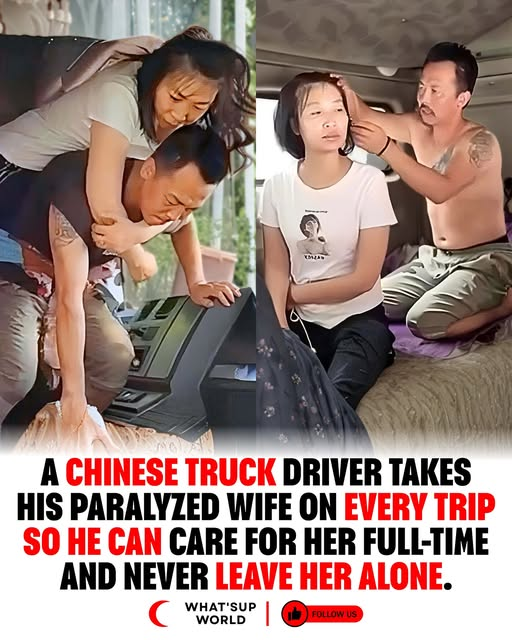
The work Nie does between stops is harder than any delivery route. He feeds her patiently, cleans her, changes her clothes, and carefully adjusts her position to prevent pain and injury. At rest areas and roadside pullovers, he helps her with simple rehabilitation exercises, using what time and space he has. There are no nurses, no shifts to hand off. Just consistency, day after day, mile after mile.
Their life on the road is quiet, repetitive, and demanding. Sleep is often short. Emergencies don’t wait for convenient locations. Yet Nie never describes his routine as a burden. He speaks of it as responsibility — not heroic, not extraordinary, just what love requires. When he calls Cao his “first love,” it’s not a romantic phrase meant for attention. It’s a statement of loyalty rooted in action, not words.
What makes their story powerful isn’t spectacle. It’s the absence of it. There are no viral speeches, no dramatic gestures. Instead, there is steady care given when no one is watching. Love expressed through feeding schedules, sore muscles, and hands that never let go. In a world that often celebrates grand moments, Nie and Cao remind us that devotion usually lives in the ordinary — in patience, repetition, and showing up again tomorrow.
They have traveled thousands of miles this way, not chasing freedom, but preserving connection. The truck is not just a workplace or a vehicle; it’s a shared life in motion. Through traffic jams, weather changes, and exhaustion, Nie keeps driving — not away from responsibility, but straight through it. And Cao, though unable to speak or move freely, is never absent from the journey.
Their story doesn’t ask for praise. It offers perspective. Love doesn’t always look like flowers or promises. Sometimes it looks like rebuilding your entire life around someone else’s survival. Sometimes it looks like a truck moving steadily down a long road, carrying not just goods, but a quiet, unbreakable bond.