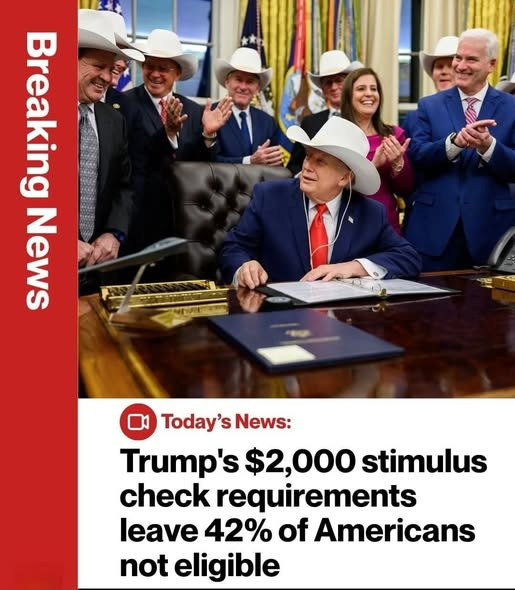
When news spread about a $2,000 stimulus check, many Americans felt a brief sense of relief. After years marked by economic uncertainty, rising costs, and lingering financial strain, the idea of direct support offered hope. But that hope quickly turned into confusion and frustration when reports confirmed that around 42% of Americans were not eligible. For millions of households, the announcement raised more questions than answers — and highlighted how uneven financial relief can feel.
Stimulus programs are often described in simple terms, but eligibility rules are rarely simple. Income thresholds played a major role in determining who qualified. Individuals and families earning above certain limits were excluded entirely, even if they lived in high-cost areas where expenses far outpaced national averages. For many middle-income earners, the disqualification felt especially sharp — earning “too much” to qualify, but not enough to feel financially secure.
Filing status also affected eligibility. Single filers, married couples, and heads of household were all treated differently, with varying income cutoffs and phase-out ranges. A small change in reported income from one year to the next could mean the difference between receiving full payment, a reduced amount, or nothing at all. For people whose finances fluctuated due to job changes, overtime, or freelance work, the system felt unforgiving and rigid.
Dependents were another major factor. Some households expected larger payments based on family size, only to discover that certain dependents did not qualify under the rules. Older dependents, adult children, or relatives supported financially but not recognized under the program’s definitions were excluded. For families already stretched thin, this felt like an oversight that ignored real-world caregiving responsibilities.
Citizenship and residency status also played a role. In mixed-status households, where some family members were eligible and others were not, payments were sometimes reduced or denied entirely. This created situations where families contributing to the economy through work and taxes still found themselves excluded from relief meant to stabilize households. For many, the policy felt disconnected from the realities of modern American families.
Beyond eligibility rules, timing and information gaps added to the frustration. Some people learned they were ineligible only after waiting weeks or months, checking bank accounts and mailboxes with growing anxiety. Others received conflicting information from different sources, making it difficult to understand whether relief was coming or not. The lack of clarity turned what was meant to be reassurance into another source of stress.
The fact that nearly half of Americans were excluded from the $2,000 stimulus check doesn’t necessarily point to a single failure, but it does reveal a larger issue. Broad economic relief is difficult to design in a country with vast income disparities, regional cost differences, and complex household structures. While the program helped millions, it also left many feeling unseen — caught between eligibility lines that didn’t reflect their lived experience.
For those who did not qualify, the announcement became a reminder that financial hardship doesn’t always align neatly with policy definitions. The conversation around stimulus checks ultimately exposed deeper questions about how support is measured, who is deemed “in need,” and whether future relief efforts can better reflect the realities faced by everyday Americans.