In Italy, adoption is governed by some of the strictest laws in Europe. Preference is given to married, heterosexual couples, and single applicants often find themselves quietly pushed aside. Luca knew this before he ever applied. As a single, gay man, he was told directly by social services that his chances of adopting a child were close to zero. Still, he applied anyway. He didn’t argue or protest. He just said the truth: he wanted to be a father, and he was willing to wait.
Years passed with little hope. Eventually, social workers were honest with him. The only children he might be considered for were those with “severe health issues” or “special needs” — children who had already been rejected by everyone else. The words were meant to discourage him. Instead, they clarified everything. Luca didn’t want a perfect situation. He wanted a child. Labels didn’t scare him. Conditions didn’t scare him. The idea of never being a dad did.
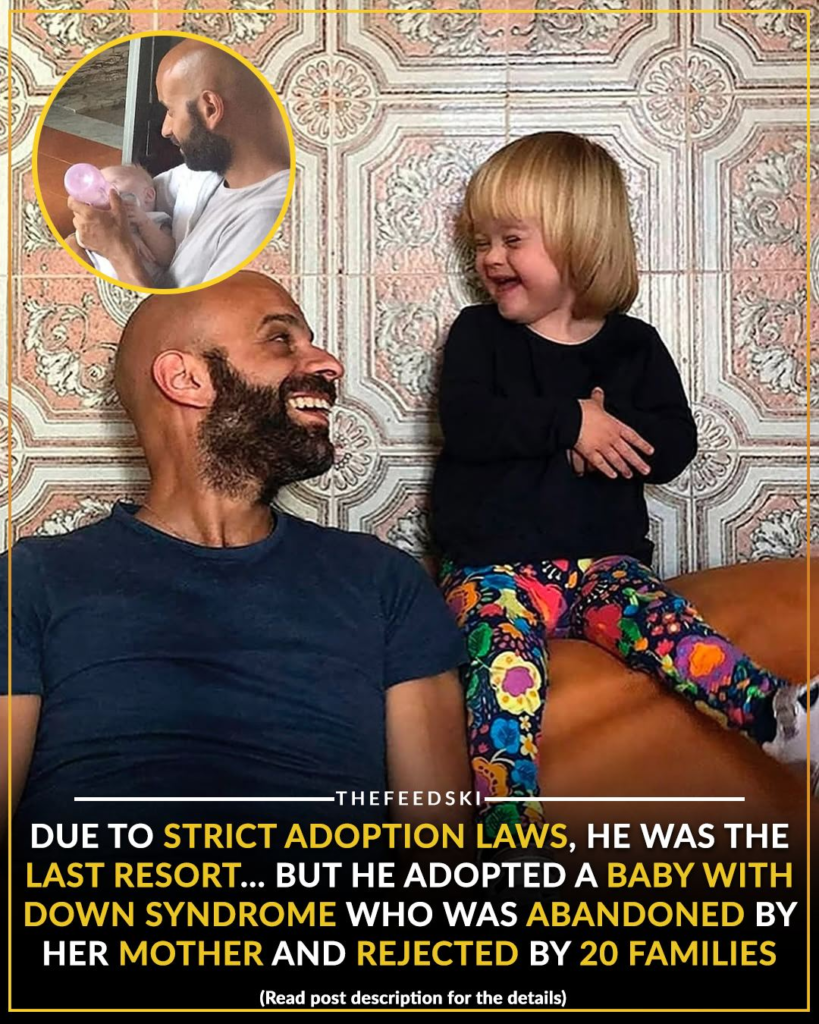
Then came the call that changed his life. A baby girl named Alba had been born less than a month earlier. She had been abandoned by her birth mother shortly after delivery. Doctors had diagnosed her with Down syndrome. One by one, twenty traditional couples had turned her down. Some cited fear. Others spoke of burden. Each refusal pushed her further into uncertainty. When Luca heard about her, he didn’t ask questions about prognosis or limitations. He asked where she was.
He rushed to the hospital and held her for the first time while she slept. She was tiny, warm, and completely unaware of how unwanted she had already been. In that moment, Luca didn’t feel like he was making a brave choice. He felt like he was meeting his daughter. The decision didn’t take seconds because it didn’t feel like a decision at all. It felt inevitable.
Today, Luca and Alba are inseparable. Their life is not free of challenges, but it is filled with routine, laughter, and deep connection. Alba goes to school, learns at her own pace, and surprises people constantly. Luca is not a “hero parent,” as he often says — he’s just a dad doing what dads do. Loving, advocating, worrying, celebrating. The difference is that his family doesn’t fit the traditional mold many expect.
Luca has since written books about their life together, not to seek praise, but to normalize what society often treats as exceptional. He writes about disability without pity, about parenthood without rigid definitions, and about love that grows outside conventional approval. Through their story, he challenges the idea that some children are “harder to love” or that some families are less valid than others.
When people tell Luca he “saved” Alba, he gently corrects them. He says she saved him. She saved him from a life defined by rejection and waiting. From a future where love was postponed by bureaucracy and prejudice. Alba didn’t arrive to complete his life — she reshaped it. Together, they are proof that family is not created by meeting expectations, but by choosing each other fully, especially when the world looks away.