The earthquake struck without warning, tearing through the village in a matter of seconds. Homes that had stood for generations collapsed into dust and broken concrete. Streets filled with sirens, shouting, and the sound of people calling out names, hoping for answers in the chaos. When the ground finally stopped shaking, rescuers rushed in, knowing that every minute mattered. Beneath the rubble were families, memories, and the fragile possibility that someone — anyone — might still be alive.
By the second day, hope was beginning to thin. Many homes had already been searched with no survivors found. Exhaustion showed on every rescuer’s face, but no one stopped listening. That’s when someone heard it — faint barking coming from beneath a collapsed house. It was weak, intermittent, but unmistakable. The mood shifted instantly. Barking meant life. Carefully, rescuers moved toward the sound, preparing themselves to find a trapped person nearby.
As debris was removed piece by piece, the barking grew louder. But when the opening was finally large enough to see inside, the sight stopped everyone cold. There was no human survivor. Instead, a Golden Retriever lay beneath the wreckage, its fur coated in dust, eyes alert but weary. The dog wasn’t trapped. There was enough space for it to escape long ago. Yet it hadn’t moved.
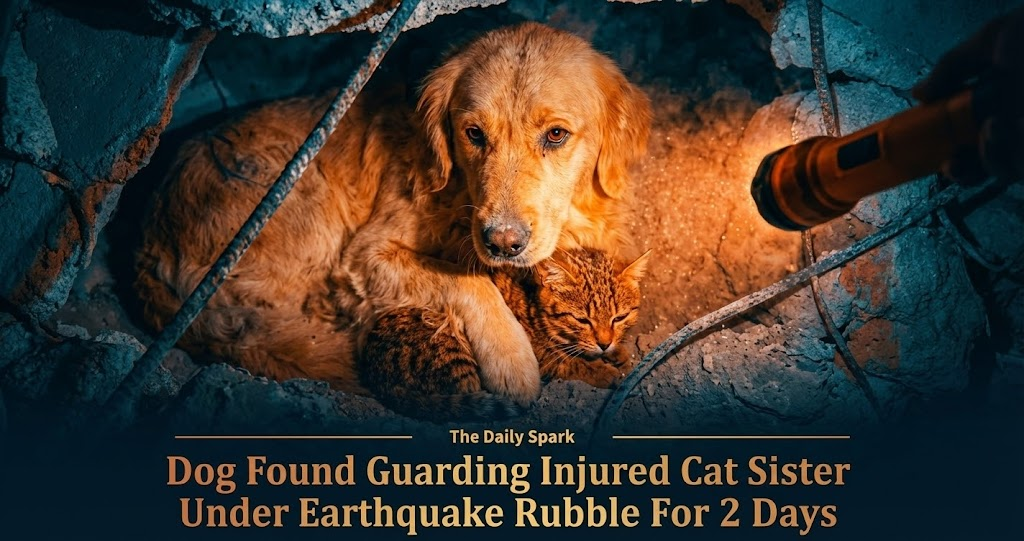
As rescuers edged closer, the dog began to growl — low, controlled, and protective. It wasn’t fear. It was warning. Only then did they notice what the dog was guarding. Curled tightly against its chest was a severely injured cat, barely moving but still alive. Broken beams and shattered stone surrounded them, but the dog’s body formed a shield, absorbing falling debris and creating just enough space for the cat to breathe.
Rescuers quickly understood what had happened. When the earthquake hit, the dog could have run. Instinct would have allowed it to escape easily. Instead, it chose to stay. For nearly two days, it remained in the ruins, protecting the cat from shifting rubble, noise, and danger. When the rescuers tried to approach, the dog growled again — not aggressively, but insistently — until they carefully reached in and removed the cat first.
Only after the cat was safely lifted out did the dog relax. It allowed rescuers to guide it out moments later, emerging into the daylight for the first time since the collapse. Both animals were dehydrated, shaken, and injured — but alive. Later confirmation revealed that they were the only survivors from that home. No humans had made it out.
The scene left seasoned rescue workers visibly shaken. Many had witnessed bravery before, but this was different. There was no training, no command, no expectation of reward. Just instinct, loyalty, and an unspoken bond. The dog didn’t understand survival statistics or rescue timelines. It understood only that another living being needed protection — and that leaving was not an option.
In the aftermath, as the village mourned its losses, this small story spread quietly among rescuers and locals. It wasn’t shared as a miracle, but as a reminder. Survival doesn’t always look the way we expect. Sometimes it’s not about strength or speed, but about choosing to stay when leaving would be easier. In a place where so much had been lost, the image of a dusty Golden Retriever guarding an injured cat became a symbol of something still intact — compassion, loyalty, and the simple, powerful instinct to protect those we love.