When people look at her, they often see the tattoos first. Ink winding across her neck, arms, and chest. Symbols, dates, faces, stories etched into skin. And almost inevitably, someone feels the need to comment. “You won’t look good at 60.” “You’ll regret that one day.” “What about when you’re old?” The remarks usually come disguised as concern, but they land like quiet judgments. For her, those words have become familiar — and meaningless.
She didn’t get tattooed to shock anyone. Each piece represents a moment, a belief, or a chapter of her life. Some tattoos mark survival. Others celebrate joy. They weren’t chosen for trends or attention, but because they felt honest at the time — and still do. When strangers predict regret decades into the future, they assume aging is something to fear. She doesn’t see it that way. To her, aging is a privilege, not a punishment.
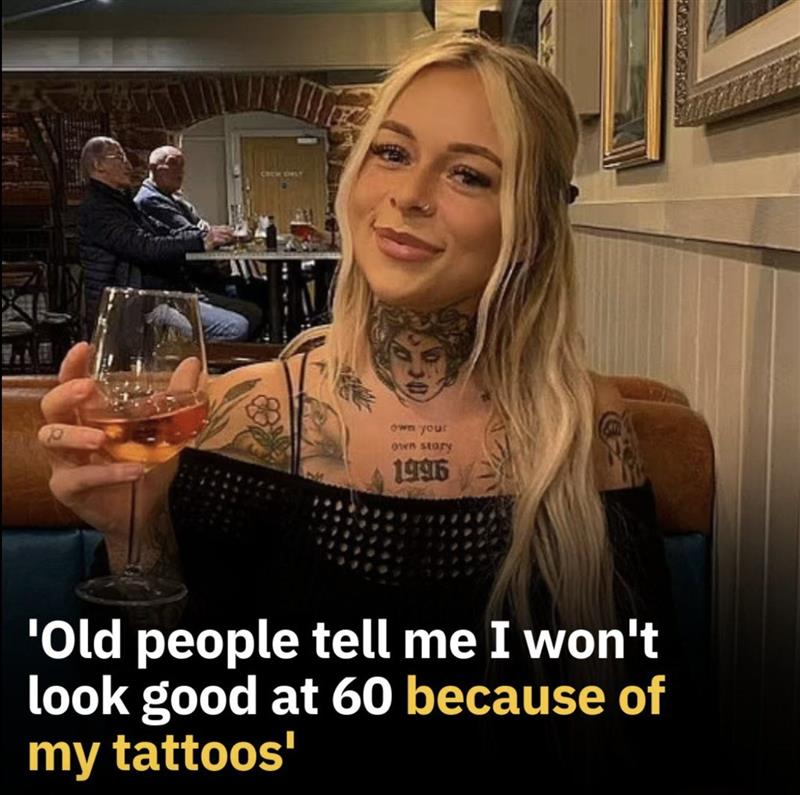
There’s an unspoken expectation in society that beauty must remain soft, smooth, and untouched to be valid. Aging already challenges that standard, especially for women. Tattoos simply make the challenge visible sooner. Lines will form. Skin will change. Ink will blur slightly with time. None of that feels tragic to her. It feels human. Bodies are not meant to stay frozen in one version forever. They are meant to carry evidence of living.
What frustrates her most is the assumption that self-expression has an expiration date. That at some point, people — especially women — are supposed to shrink, quiet down, and become less visible. Less colorful. Less bold. As if personality should fade along with youth. She rejects that idea entirely. She doesn’t plan to erase herself to make others comfortable. Not now, and certainly not at 60.
When she imagines herself older, she doesn’t picture regret. She pictures familiarity. A body that has lived through things and shows it. Wrinkles tracing laughter and grief. Tattoos softened by time, each one still telling a story — maybe differently, but no less truthfully. She believes that looking “good” at 60 isn’t about meeting someone else’s standards. It’s about feeling at home in your own skin.
Ironically, many of the harshest comments come from people who themselves fear aging. Tattoos become an easy target, a visible symbol to project that fear onto. It’s simpler to criticize ink than to confront the reality that all bodies age, whether marked by tattoos or not. She understands that now. The comments say more about the speaker than they ever could about her future.
She isn’t trying to convince anyone to love tattoos or make the same choices she did. Her point is simpler: fulfillment doesn’t come from planning how acceptable you’ll look decades from now. It comes from living honestly in the present. If she reaches 60 with her tattoos faded, her hair changed, and her face lined by time, she’ll consider that a success. Because it means she lived long enough for all of it to happen.
Aging will come for everyone. Ink or no ink. What remains is how fully you allowed yourself to be seen along the way. For her, tattoos are not a mistake waiting to happen — they are proof that she chose herself, again and again, without waiting for permission. And that, she believes, will look just fine at any age.